
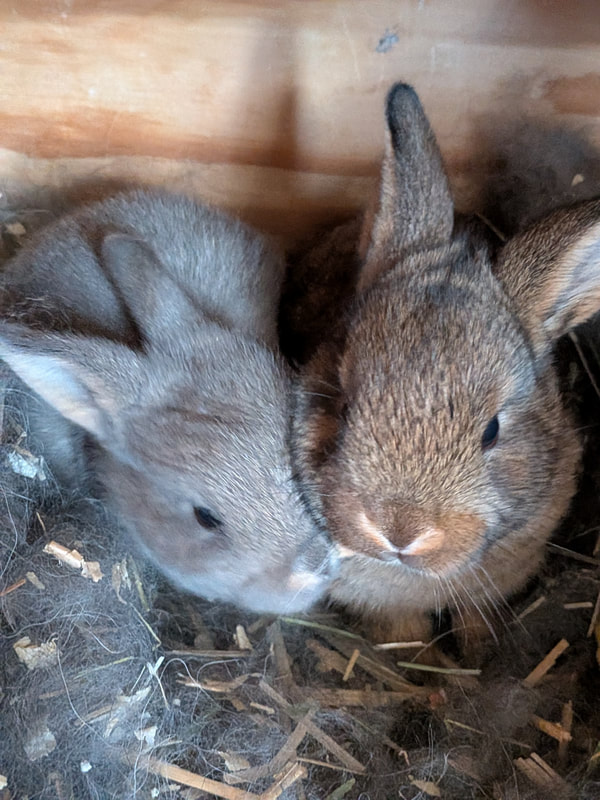
Ten years ago, as I was dreaming of a homestead, I decided the best meat production would be rabbits. I researched and read, and then took my kids to visit a family that raised meat rabbits. We saw their setup, played with the babies (grow-outs), and bought a frozen rabbit to try (if we can't eat it, we should not raise it). Once we were settled on our property, we decided to try Cornish Cross meat birds. I already had the equipment and knowledge about chickens, so it seemed the logical plan. We raised and processed meat birds for several years. Each year, the price of chicks, shipping, and feed went up. They were messy, stinky, and had to be kept in the garage for a while, and that was not fun! |



 |  |
I read that I should clean the wound, and apply triple antibiotic ointment, then keep it covered. I carefully washed Snow's head with warm water and gauze. I attempted to apply the ointment to the dry wound, but it just slid off. I finally put the cream on the dressing and just stuck it to her head. It fell off after an hour, but it was better than nothing. Snow spend the first night in the house. The next day, I moved her to the garage along with the heat lamp and water laced with Sav-A-Chick Electrolyte powder. She was beginning to walk around some but still seemed stunned and not well. I looked again on the internet and learned about Vetericyn Plus wound spray. We had used Blu Kote when disbudding goats, but the spray is so big I worried about getting it in her eyes. The Vet spray was perfect. We abandoned the gauze and began to spray the wound three times a day. She began to improve.

Within a few days, she was acting normal. She began to eat and drink as usual and even began to make noise. A week and a half later, she was ready to brave the outside again. Because her wound was still open, I could not put her with the other chickens. I set up a fence in the back of the run, and that is where she spent the days. At night I would bring her into the garage with the heat lamp. By the time May rolled around, she was healed. The wound was scarred over, and some feathers were growing along the edges. She moved back into the coop without any problems.

Today she is perfectly healthy and accepted, part of the flock. The wound scars remain; feathers don't grow there, so my son calls her baldy.
I am amazed at the strength and resilience I saw in this small bird. Life often feels overwhelming, like there is no use trying. But, if a chicken can find the will and strength do go on under impossible circumstances, so can I.
I am amazed at the strength and resilience I saw in this small bird. Life often feels overwhelming, like there is no use trying. But, if a chicken can find the will and strength do go on under impossible circumstances, so can I.


I had seen YouTube videos of people making treats and cookies for their goats and wondered, "WHY?" That seemed like a lot of work when they are just as happy with a raw peanut, shell and all, that takes 0 time to prepare. But I changed my tune when I decided to use a natural wormer. First I tried Food Grade Diatomaceous Earth. I had some I was using as a dust for Goat Lice, and I had read that you can sprinkle it on the goats' food to help with internal parasites. So I tried it! My picky goats refused to eat. Next I read about an herbal mix you can buy on line. Again my goats turned up their noses. I tried mixing the herbs in water and using as a drench. It was a mess!!! Now I make goat cookies and they can't get enough! It is their Sunday treat! If you have something you want your goat to eat, but they won't touch, or if you really love your goat and want to make her happy, you should try this!
GOAT COOKIES
Making cookies is easy. I would love to give you a recipe that is easy to follow, but I don't measure anything when making them so you will have to experiment and find what works for you. Here are the basics.
You will need:
- Herbs, diatomaceous earth, or other powdery substance that is good for goats but they don't like (optional)
- Wet stuff: unsweetened apple sauce, fruit that is too mushy to eat, leftovers from making applesauce, pumpkin mush...
- The Bait: sweet stuff like Molasses and/or Honey to cover the taste and smell of the herbs
- Treats: chopped apples, carrots, pumpkin, cucumbers, grapes, raw peanuts...
- Dry Stuff: Dry Oatmeal or flour
- I start with my herbs and diatomaceous earth. If you are not using these things, skip to the next ingredient. I mix the appropriate amount for my four goats into a bowl.
 |  |  |
- Then I add the wet ingredients. Fruit sauce and molasses. I put enough to make it wet but not so much that I need to add a lot of oats, that just makes more dough. I would guess about 1/2 c. sauce and 1 T. molasses or honey.
- Next comes some chopped fruit or veg. My goats love carrots and I usually have them on hand because my kids like them too. I chop about 1/4 cup and throw it in!

|  |
 |
|
|  |


hickens need calcium to be healthy and to produce eggs with strong shells.
To find the best source of calcium, you needn't look farther than your coop.
A common sign that your laying hen has a calcium deficiency is thin eggshells, or eggs with gummy or nonexistent shells. This is not a pleasant thing to find in the nesting box or to try and carry into the house. Sometimes a young hen my lay shell-less eggs when they are first practicing, but if your mature layers start to do this, you may want to add some calcium to their diet.
I am a big believer in the phrase,
“Use it up. Wear it out. Make it do, or do without.”
I try to find natural, cost-efficient ways to deal with everyday problems on the homestead. I found the simplest way to add calcium is to give the chicken their own eggs. According to Healthline, Eggshells are 40% calcium, and half a shell can provide up to 1,000mg of calcium. The trick to feeding chickens eggs is to make it unrecognizable as an egg. That way, they will not start eating their own eggs, leaving you with nothing to make for breakfast!
Here is what I do.
HOW TO FEED CHICKENS EGGS
First, make up a batch of scrambled eggs with no salt or butter. I give those right to the chickens along with the table scraps we dump in the run every morning. This add to their basic health and protein.
As you crack eggs, place the shells on a foil-lined cookie sheet and pop them in the oven at 350* for 30 min or so. The high temperature will dry them out, kill any salmonella, and make them easy to grind.
To find the best source of calcium, you needn't look farther than your coop.
A common sign that your laying hen has a calcium deficiency is thin eggshells, or eggs with gummy or nonexistent shells. This is not a pleasant thing to find in the nesting box or to try and carry into the house. Sometimes a young hen my lay shell-less eggs when they are first practicing, but if your mature layers start to do this, you may want to add some calcium to their diet.
I am a big believer in the phrase,
“Use it up. Wear it out. Make it do, or do without.”
I try to find natural, cost-efficient ways to deal with everyday problems on the homestead. I found the simplest way to add calcium is to give the chicken their own eggs. According to Healthline, Eggshells are 40% calcium, and half a shell can provide up to 1,000mg of calcium. The trick to feeding chickens eggs is to make it unrecognizable as an egg. That way, they will not start eating their own eggs, leaving you with nothing to make for breakfast!
Here is what I do.
HOW TO FEED CHICKENS EGGS
First, make up a batch of scrambled eggs with no salt or butter. I give those right to the chickens along with the table scraps we dump in the run every morning. This add to their basic health and protein.
As you crack eggs, place the shells on a foil-lined cookie sheet and pop them in the oven at 350* for 30 min or so. The high temperature will dry them out, kill any salmonella, and make them easy to grind.

I then grind the shells to bits. I use a mortar and pestle. And I save this chore until I’m very frustrated. Pulverizing eggs, and the crunching sound they make is very satisfying and stress relieving.
I then sprinkle the powder on the chicken’s food. Eggshells are also useful for keeping slugs and snails away from the plants in your garden. Just sprinkle a ring around the plant, and the slimy critters cant slide over it without getting injured.
Good Luck!
References:
Arnarson, A. (2017, November 17). The Benefits and Risks of Eating Eggshells. Retrieved from Healthline: https://www.healthline.com/nutrition/eggshells-benefits-and-risks
Good Luck!
References:
Arnarson, A. (2017, November 17). The Benefits and Risks of Eating Eggshells. Retrieved from Healthline: https://www.healthline.com/nutrition/eggshells-benefits-and-risks
Author
"I've been thinking..." is my husbands least favorite phrase. Every time he hears it he know there will be lots of work, money, and time involved. My name is Anne. I'm not an author or grand storyteller but I do get most of my homestead information from others. So, I thought I would pass on my experiences and ideas. I hope they give you information and ideas to help you get thinking.
Archives
August 2026
January 2020
December 2019
Categories
All
Animal Health
Birth
Chickens
First Aid
Goats
Kid
Pregnancy
Rabbits
 RSS Feed